Showing posts with label 18th C. Show all posts

Monday, May 12, 2014

Casting Season

 It's casting season here at the Lead Gardens. The weather has "springed up" and it's perfect for getting
outside and starting on some summer casting projects. Outdoor casting has the advantage of keeping the  nasty metal fumes out of the house.

I purchased three of the new 40mm Prussian molds from Prince August. I found the new moulds to be a nice change from the sometimes awkward poses of PA figures. The apparently have listened to those of us who war-game with these big guys and need a versatile figure that will paint up to most 18th century types.

Here are the wargame friendly features of the new molds:

1. The mould will cast two figures at a time, effectively halving casting time---particularly if you go for big units (mine are established at 40 figures) I got this new unit done in about 5 hours in two sessions over a weekend.

2. The moulds have two separate heads-- the basic infantry mould has both a musketeer in tricorn heads and grenadier heads in mitre two each so casting the mould will supply the optional heads as well.  The officer, standard bearer, NCO, drummer molds have tricorn and fusilier heads. I bought all three moulds so I've got lots of spare heads now (to do a fusilier unit will take a lot of officer casting because the fusilier head only comes in the drummer mold)

3. The detail is more accurate for the Prussians.

4. The pose matches the older infantry advancing pose, though I hear they will be coming out with a march attack pose later.

5. The heads cast separately but are very easy to attach thanks to a nice sturdy peg cast on the head in conjunction with a plastic rod that is inserted into the mould before casting. This ensures that the hole for the peg in the body of the figure is perfectly sized.

 I went with a unit of grenadiers that will represent one of the units from my Imagi-nations. I have been upscaling all of those figures from my original collection of 30mm RSMs.


The only downside of the casting session was having to do a bit of vent cutting to get the heads to cast properly. That is typical of PA moulds so not a big deal really. The only thing I had real trouble with was getting the officer's sword and had to cast (it's a separate piece)…but I think it's because I use old figures for my metal and I'm guessing if I used some of PA's higher quality casting metal, it would make things easier.

I'll be posting progress on the painting of this unit soon.

Cheers!

Thursday, December 20, 2012

New Musketeers!

 Just finished a new company of 40mm Prince August Homecast...these fellows will do service as a unit of my Imaginations. I'm gradually scaling up my Imaginations collection to 40/42mm to fit in with my French and British so I'm taking my already named units and imaginary history and up-scaling them for my home-casting project.
finished unit with the miscast muskets ready for repair...
These castings are from the newest PA molds that came out last November. As always the PA casting is pretty easy except for some musket barrels that did not cast to the right length. So I used my flat toothpick fix that works really well for most PA musket sword casting repairs. It works as well as the round toothpick solution for wagon/gun wheels.
 I also did a few minor head modifications to get better three dimensionality and some more extensive mods to make a standing flag bearer...but the PA figures (particularly the artillery castings) do well as a base for unusual conversions.


The toothpick fix...super glue works as both the adhesive and as a way to seal the wooden toothpicks.

All painted up, the toothpicks are pretty convincing!

And as a unit, the fix is almost undetectable!

Ready for the field!

Sunday, December 9, 2012

Inspired

 This week has been very productive here at the Lead gardens both because I am approaching the end of the teaching term and have a bit more time and because of the trip my wife and oldest son took to New York this past few days has given me the run of the house with my youngest daughter who is pretty easy to take care of. I managed to get some pre-dreadnoughts built and painted and had a few fun games to get me into the "holiday mood".  This afternoon I made good progress on painting up the Union figures for my Battle Cry game. Late today I was ruminating on the "Memoir of War at Sea" rules and had an, "oh wait, I have something that will work for this!" moment. So I went out to the garage (where my "gaming stuff" is stored) and I unearthed a box of 1/600 sailing ships that I had built more than 20 years ago when I was first living on my own after my first marriage went kaput. In those few months I spent in a sparse apartment without much in the way of furniture, and lots of time on my hands, I bought a bunch of Airfix 1/600 "Victory" and Heller 1/500 "Le Superb" plastic kits and set to building converting and scratchbuilding a small French and British fleet of sailing ships.
The original 1/600 Airfix kit
 I really got into it and the results were very satisfying even if I had no really good rules to use for solo gaming in the period.
This is the Heller 1/500 Le Superb unfortunately I think out of production, and I've got only four unbuilt kits left. The Victory is still available.
 I learned a lot about scratchbuilding back then and I still have a few kits left unbuilt. The scale is great for small actions.
 So I'm thinking a variant of the variant "Memoir of Battle at Sea: Age of Sail" is in order...and this afternoon I sat down with pencil and paper to do just that. As soon as I get a draft up I will post it and see what my readers think.
Some of the smaller ships were entirely scratchbuilt...and unfortunately are in need of some repair


 The scale of 1/600 is really beautiful for sailing ships and a good size if you want to do some basic rigging. The scale works also because ratlines can be simulated with a triangle of window screen cut to the proper size.
A big French three decker...the 120 gun "Orient"
 I tried to model each of these after a real ship and for this rule variant I thought a nice goal would be to make a simple game that still was able to account for different ship armaments. I've got some simple formulas cooked up based on the broadside weight to rate the ships for number of battle dice to roll and and the tonnage to give a damage value. Next I'm cooking up some sailing rules that will hopefully keep everything really simple  and in the spirit of Bob's variant on the M44 rules approach.
Some of the smaller ships are pretty damaged but I think in time I can bring them back to full glory! This is the British 44 gun frigate "Sprite"

The whole collection.
I'm pretty excited about this new direction, but of course, as always, the specter of being spread over too many projects looms on the horizon...but what the hell, I never let that stop me before!

Wednesday, November 14, 2012

New Prince August Molds

Just getting home and tucking into an afternoon martini after a tough day at work is usually enough for me to feel good, but today was extra-good... my mailbox was stuffed with a box from Prince August with a fat box of some much needed molds! These arrived here in Virginia in record time...a mere week across the pond. I think the folks at PA have made a nice effort with their new website and new molds to step up their business and I really hope all the PA fans out there encourage them. Also included is a nice new catalog with good illustrations of all the available figures.

I also realized that I had forgotten that I had submitted an order for 2, 40mm Karoliner "914" molds in loading poses so I now combined with the firing poses I already have, I've got the ability to cast up some "freikorps" light troops in half the time! I was also inspired to add a sapper/engineer company to my armies and have some base figures for conversions so the new artillery figures will do well in that regard.

...Now where are those bloody olives...


Wednesday, October 3, 2012

The Armies March

The English defend.
 I set up a new battle on my newly upgraded table (feels like a glorious 8'x5' after a few months relegated to the 6x4 dining table). This is actually the second battle but who's counting...
The defenders hold the bridge perimeter.
 In this scenario, I used a variation of the "Raid on St. Michel" campaign book (teaser 5) assuming a larger force holding a bridgehead and needing to hold the bridge open to get all its baggage (and loot) across the river while being attacked by a strong pursuing force.
Irish Regiment Bulkeley (now with a full compliment of 2 "companies" of 16 men) ...all that is lacking to be cast up is a mounted colonel, a second flag bearer and an NCO.

A church and walled graveyard dominate the center of the field

The French...Infanterie Regiment Lyonnais and a battalion gun on the flank facing a long march across an open field under the guns of the Brits.
I'm hoping to get this battle underway towards the end of the week...until then it remains set up. It makes me happy and reduces the end of the day work stress just looking at it, even if I don't get to roll some dice immediately.

Sunday, September 30, 2012

Artillery Stick for "2/3s scale Charge"

 Working as I do in a school of architecture here in Virginia has its perks especially at the end of the term when students pack up their studio stuff to head home. It's usually a good time to check the recycling bins for useable materials that can be re-purposed for gaming. This past summer term found me in the possession of several nice 48" wood strips leftover from a shop project. I made off with them and did a bit of painting and lettering on one of them to make a pretty serviceable artillery stick for "Charge" at 2/3s scale.
The large number is the to hit number and just to the right the casualty D6 to be rolled...on the upper right of the range band is the to hit for light battalion guns (a house rule of mine...lower to hit probability by one, but the same casualty D6)
The end of the artillery stick has the 45 degree field of fire marked and with a bit of graphic flame to enhance the "abstract" look of the thing...which to me is paramount in an old school game.
I had some stencil templates to do the lettering and a coat of white artist gesso did good service as a basecoat. I did two coats with a light sanding between coats to make a nice smooth surface, though if you were in a hurry, the gesso covers in one coat. (the stencils are a hard-to-get metal reproduction of the classic set used by the famed architect Le Corbusier back in the 1920s...so they look pretty good and have a "workmanlike" look... but I think one could get just as nice an effect with an inexpensive paper stencil of the right size). The artillery batten is about an inch and a half wide so it works great to also indicate roughly any blocking of the field of fire by intervening friendlies.

I'm also thinking of doing some tweaking of the melee rules to take into account some things like grenadiers, light cavalry and lancers...that would have some advantage in the melee rolls but not as dramatic as the doubling of the D6 in the cavalry versus infantry melee situation.

I'm enjoying the 2/3s scale version of the rules (many thanks to Ross for the suggestion) and it works with my table depth very well.

Saturday, September 29, 2012

Battle of St. Michel: Second Attempt- The Report

British grenadiers and the 12th regiment of Foot begin their assault on St. Michel
The battle opens with the British advancing smartly in column of companies to cover the expanse of open ground as quickly as possible.
The 8th Regiment of Foot (King's) deployed in line covers the flank of the assaulting column.


Attentive readers will notice I've mislabeled the Colonel's stand (in this game hit early...) as the Lorraine Regiment...They are actually painted as the Regiment Lyonnais....I am getting old and confused..!
British battalion guns do some serious damage to an exposed company of the Lyonnais Regiment.
I simulated indecision on the part of the French of when to release their cavalry by rolling each turn for their Brigadier to convince the reluctant CinC to charge forward. About turn three they finally surge forward.
French Horse bear down on the British line.

The 12th Foot and converged grenadiers move to assault St. Michel

light cavalry clash on the flank
In the center the French cavalry charge the 8th regiment of foot...

The assault column closes in...


overview about halfway through the battle...the French regrouping their horse after an unsuccessful charge and the British assault column closes in on the outskirts of St. Michel


The defenders of St. Michel, Infantrie Regiment Lyonnais

French CinC

Col. Skelton of the 12th foot leads from the front but is one of the first to fall...

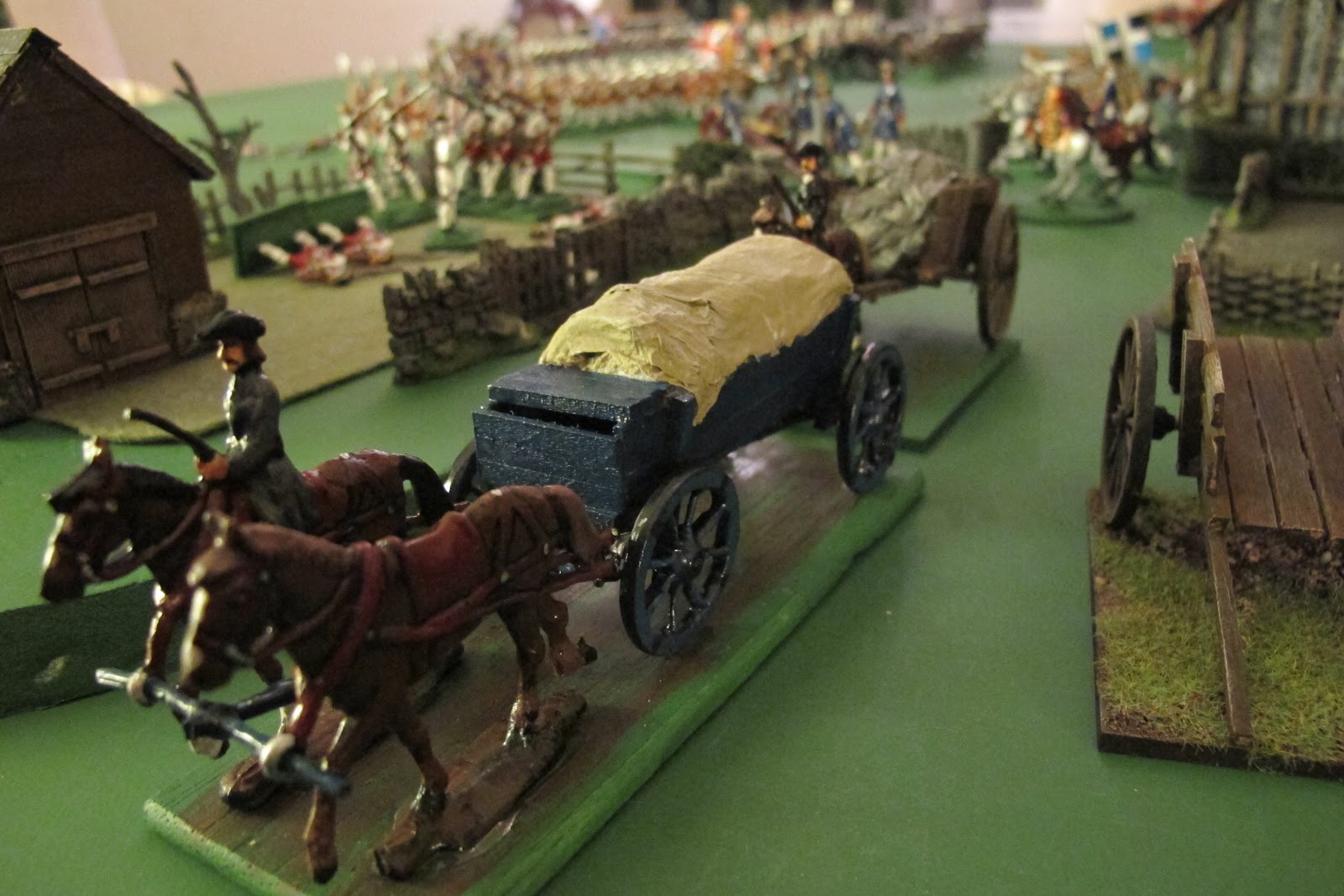
The objective...the pay waggons

Light infantry skirmish

The British column begins to break up.


The French Cuirassiers make another charge on the British left.

cavalry action


Concentrated musketry and cannon fire shatter the British in the final moments of the assault.

The final blow to the British is delivered by a successful charge of French heavy horse.

This battle was fun...but had to be taken down fast.... but my sights were set on getting a larger table set up and some more figures painted up...so in my next post, another CS Grant teaser from the "Raid on St. Michel" book