Showing posts with label Rules. Show all posts

Thursday, October 25, 2012

More Crazy Tiny Wargames

 I'm continuing to tinker around with very tiny wargames using the Portable Wargme Rules. Even my wife was, "wow, that's really tiny!..." so I guess that's something to be said...
I also took a cue from the blogs out there in that I put the "Diceshaker" app on my ipad and used it to generate the die rolls. It actually works really well and is a sort of no nonsense die rolling app that works just fine for this.

I played Quatre Bras out a couple of times with the British winning the first go and the French the second...so fun all around. Such a small game is pretty cool because I just kept it set up on the kitchen counter and played a few turns over my coffee this morning before the kids woke up and I headed off to work...and without the tell-tale clatter of dice, I was able to keep the wife slumbering too!
French columns assault Gemioncourt Farm


French columns take a drubbing from disciplined Brit volleys...

A second game experimenting with a gradual arrival of Brit reinforcements as in the historical battle...

The French get the better of the British left in the initial stages of game 2.


The Black Brunswickers held strong in Gemioncourt Farm in both games despite heavy assaults from French columns.
And finally I had a few minutes this afternoon after work to dig out some old plastic minis from a Parker Brothers Battle Cry game from the 60s...the board is long lost but I still have the minis so I pressed them into service. This is a hypothetical layout of Gettysburg at a very abstract level without ridges (that I am going to make this weekend) to see if I can stretch Bob's portable rules to their limit on a 7" square?!

Wednesday, October 17, 2012

Two Gridded Games

The Valley of San Lorenzo
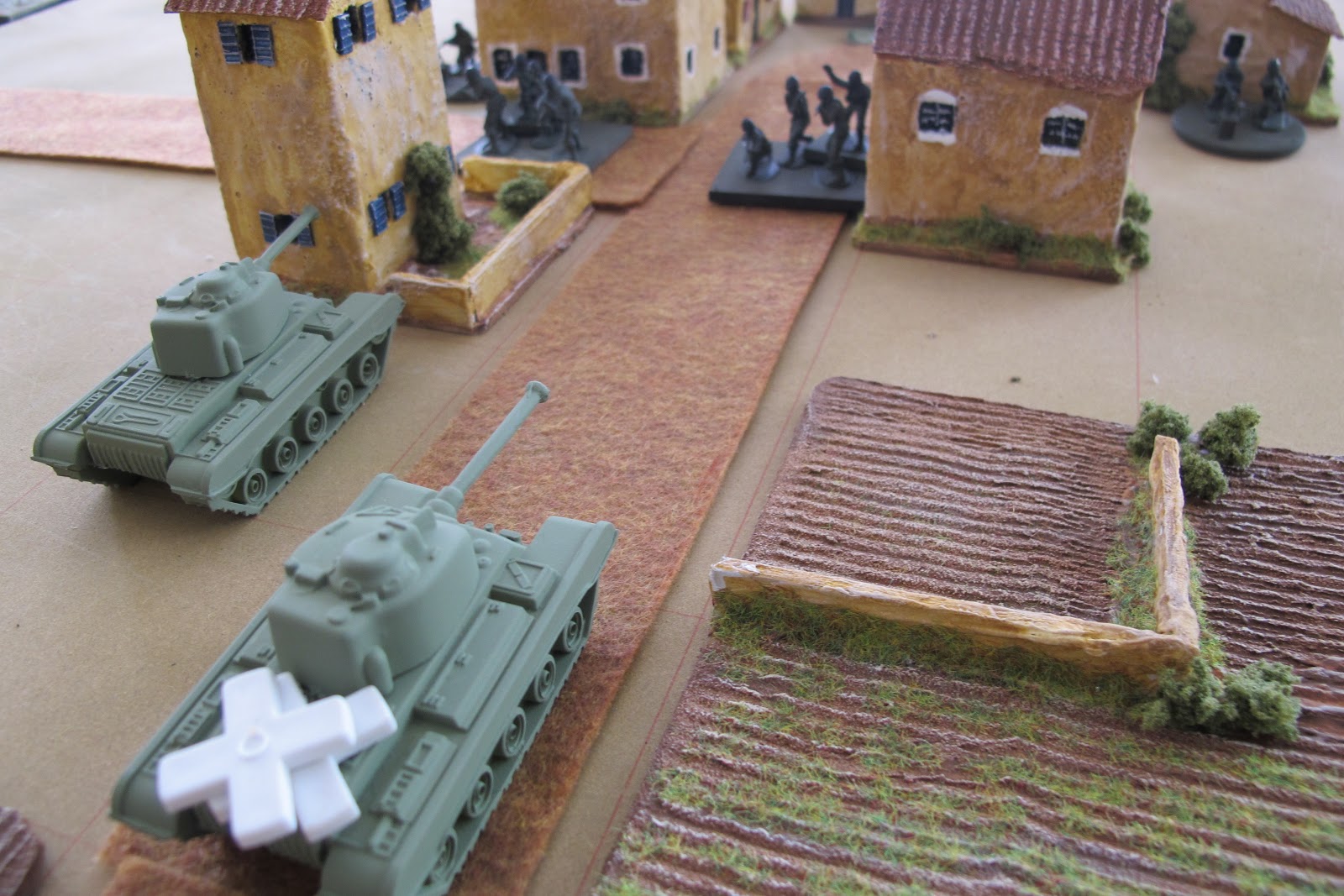
 Inspired by the new edition of Bob Cordery's Modern version of the Portable Wargame I dug out my generic WWII plastic figures and a couple of odd scaled plastic tanks all of which came from dollar store sets from China. I set up a scenario set in 1943 Italy where an assaulting force attempts to capture a village surrounded by a rough semicircle of ridges.
Army Tan playing the role of the Americans
 The idea was to play out an experimental game first using Memoir 44 as is on a square grid with a few added rules for MGs and Mortars. ( MGs get a 4-3-2-1 rating and count as 3 hit infantry  and mortars a 3-2-2-1-1 counting as 2 hit artillery) Then to reset the battle and use the Portable Wargame Rules. Not so much to compare their merits, but to just enjoy gaming with both of them.
Army Green playing the role of Germans
 I'm also keen to put my homemade Spanish Village to use and since my SCW collection is still under construction, these odd little plastics will serve in their place. They are just a basic color spray coat with the helmets picked out in a darker color...pretty effective for a "quick and dirty" set up.
First game using Memoir 44

the table is a 4'x4' gridded with 2 1/2 " squares 18 by 18

The Americans approach the town

US armor assaults the outskirts driving back the defenders temporarily

Tough German defenders inflict damage as the tanks outrun their infantry support

On the right flank the GIs fight their way up the steep slopes of San Lorenzo Ridge
I just used d6s to count hits and I counted plowed fields as "rice paddy" terrain as per M44 specs.
The advancing US infantry take casualties from the Germans who have re-occupied the outskirts of the town

The battle swings in the defender's favor as one of the American armor units is destroyed by close assaulting infantry

Though the Americans manage to clear a portion of the ridge, their attack stalls and the Germans hit their 6 victory points and get a win.
So all in all a simple, somewhat crude looking game but fun nonetheless...and in keeping with the abstract level of a gridded game. The M44 rules worked just fine using a square grid (I did not allow diagonal range counting) and playing solo I just dealt each new command card face down and then played the opposite side before turning it up. A fun game for sure!

 So on to the next game using the Portable Wargame rules.

Saturday, July 14, 2012

Not Quite Portable Wargame

 After my last post and some thinking on how to use a pile of bases for a new and inexpensive summer project. I realized that I had forgot about a batch of Jacklex and Ral Partha (20/25mm figures) colonial (NW Frontier) figures I had worked on last year. I had intended to base them individually and use TSATF skirmish rules with them, but never really got the urge to complete the stuff. So I thought they might work well with the "bases without an army" problem mentioned in my last post. So after a week of basing and painting a few more to fill out the collection I managed to put together two armies for use with Bob Cordery's "Portable Wargame Rules."

I now have a British vs Pathans collection and the project has turned out quickly and I managed to get in some unexpected gaming this Saturday due to some timely babysitting on the part of my wonderful father-in-law.
British punitive column deploys to teach the Pathans the inevitability of civilized might! Sikhs on the left, Ghurkas on the right and the 72nd Highlanders in reserve. (3 stands is a typical colonial battalion)
I based the Brits 6 to a 40x40mm base and the Pathans 4-5 to a base and used the old Peter Gilder trick of leaving off a few figures and filling in with terrain on the bases. I got a few more bases out of the project using this method and the Pathans look appropriately irregular. The armies are a bit larger than the 12 units recommended in Bob's early version of "TPW" so my Brits have 12 bases and the Pathan army is a bit larger at 16 bases/units. But my table is larger as well (18x18 grid squares each 2 1/2" square)...all in all enough room for everything but still fits on the dining table.

I mixed in the Ral Parthas with the Jacklex Pathans to minimize the discrepancy in the sizes of the figures (the Rals are just a bit bigger but the overall effect works fine with an abstract game like "Portable Wargame"). One trick I found was to put the larger figures towards the center of each base and the smaller Jacklex to the outside so the scale difference is less noticeable.
Jacklex 20mm 72nd Highlanders and Ral Partha Sikhs in the background. The field gun and crew is Jacklex.
 One of the challenges was that I wanted to keep the old school shiny look with unflocked bases so adding rocky terrain to fill the Pathan bases posed a bit of a problem. I decided to paint the bases an olive green and simply glue the rocky terrain right on the base...thus keeping the overall abstract quality of the armies consistent with both the rules and the old school figures. It seems to work (at least to my eyes)...
Pathans lie in wait
 Some of the glue is still drying in these pics so you can see how straightforward the basing scheme is...(we don't need no stinkin' flock!  ;)
 I used 15mm desert buildings from Battlefront for the village. They are small and fit the 2 1/2" square grid nicely. I decided to go with a square grid rather than hexagons since I use hexes with my 6mm Naps and needed something simple and even more "classic".
 Cork tiles were pressed into service to make hill contours.

 I also am working on some additional rules to add period chrome to the basic rules. I have added a "Heroic Action" rule that I think adds some interesting color to the game: Each army can have a number of individually based leader figures that represent company/regimental officers in addition to the CinC. These figures move with the "company" (I assume stands are company sized) and when in close combat can be risked for a re-roll of a Close Combat die. Regardless of the second roll the leader figure rolls to "risk himself" in the action 4,5,6 resulting in the leader being lost...and or "mentioned in dispatches"... The rule adds a bit of color to an otherwise abstract army level game, but I think gives a good reason to paint up some cool leader figures! I made the grid squares large enough to fit both an infantry base and a leader figure...so 2 1/2" squares seems to do the job nicely.
The Sikhs assault a wooded spur with an officer in the combat and the Ghurkas in support

Close Combat!
I'm now painting another unit of Jacklex Punjabis. The basic stand will represent a company and three companies plus one or two leaders will form a British "battalion"

It all seems to work and is ripe for further tinkering with additional period "chrome". I'm also seriously thinking to try this same approach with Spanish Civil War so...when my next check comes in....

Thursday, February 11, 2010

18th Century...The Return!


Sometimes a ruleset will reinvigorate my interest in a period. In this case Rick Priestly's Black Powder rules have got me going again both for my 18th century ImagiNation stuff and for Horse and Musket in general...I'll be posting a more detailed report of the rules but for now, suffice to say that I've been re-reading Charles S. Grant's "The War Game Companion", and his "Raid on St. Michel" campaign in addition to playing through the Black Powder rules using my 6mm Naps, some pictures of the games are shown here.


French massing to the attack...terrain sculpted using "Sculpy" clay...(works great for 6mm)...


Brits and Portugese ready to resist the assault. ( all the figures are Adler 6mm)

I played through a 6mm battle but realized that I was missing some critical elements in the rules, so I set up another game and things worked out much better. It always takes me a few plays through set of rules to get in to the finer points of play.

Playing these rules has also inspired me to finish a bunch of 25mm RSMs that I been sitting on waiting for inspiration...so now the 25s are finished and the ImagiNations game is back on!!!...more on that in the next post. Until then, here are images of my 6mm Adlers in action.


French attack columns try conclusions with a solid Highland line.


French and Brit Cavalry go toe to toe!


Overview of a 6mm battle...the table width is a mere 24" ...just enough to fit on my kitchen countertop


The terrain boards are Masonite (or "hardboard" for my Brit readers...), simply painted with roads and rivers to be used "geomorphically"... I made them a long time ago for a Franco Prussian War 15m collection that I still occasionally play...and since the "Black Powder" rules do encompass that period as well, I may break out my Franco Prussian War stuff as well.

Nothing better than a great "toolbox" set of rules!

Friday, January 29, 2010

Black Powder Rules- First Battle


The valiant men of the Konigreich der Bleiherzen and the army of the Grand Duchy of Grolstein once again come to blows along the frontier between my two imaginary countries. For this battle I used one of the Table Top Teasers from the Charles S. Grant's scenario book published by Battlegames magazine to test run the new set of "Blackpowder" rules I just received from Warlord Games.

It's been a long while since these two implacable foes have faced off on the "green mile" here at the Lead Gardens and the arrival of Rick Priestly's new rules has inspired me to have a go at an 18th century battle after a long hiatus...

For this scenario, the men of the Konigreich are defending their borders along the river that divides the two countries. The Grand Duchess's troops are again testing the border defenses by attempting to force a critical frontier bridge. I followed the set up specs in the Grant teaser faithfully so the forces as per the published scenario (The Bridge At Kronstadt). The forces were about a brigade on each side with the Grolsteiners outnumbering the Bleiherzeners by about 2:1. The figures are my 25mm RSMs painted for each ImagiNation plus some additional Prussians and Austrians to fill out the armies.

First off, I'm not going to give a detailed review of the Blackpowder rules since there are some already complete reviews out there...but just a report of the salient points of play and my very first impressions of the rules. ( for a pretty exhaustive and accurate review go here...). What I was most interested in apart from the way the rules play in general, was the way my particular collection, based as per the classic Grant rules would be adaptable to the Black Powder system.


Grolsteiners move to capture Kronstadt in the distance.

In the early turns of this battle, the rules really started to show their colors almost immediately. One of the most important aspects of play are the command rules which give you a chance to issue orders to units under the various commanders in your army. The Grolsteiners had a cavalry brigade commader and a infantry brigade commander who served as CinC, while the Konigreich defenders were only commanded by a brigade commander (but with a higher command rating)...Unlike the popular Warmaster Ancients rules by Rick Priestly, these rules have a more subtle and speedy command phase that allows commanders to test against their staff rating by rolling 2D6 (usually between 7 and 9) to issue an order. The rules require that players state the orders out loud and that must be great fun in face to face play but since I primarily game solo, the idea that my wife might hear me shouting from my gaming space, "The Konigswald Dragoons shall advance at the charge and drive the enemy from the ridgeline!"...made me decide to just imagine saying the orders.

The degree to which the command roll succeeds gives you the number of moves that the unit (or entire brigade) can perform. Thus single, double or treble moves are possible...or worst case the general rolls bad and nothing happens. This gives the game a really fast moving feel and cavalry given the right conditions can really fly across the table...all in all quite exciting! The authors state the games works best with large forces and big tables and I can see how on a very wide table the games could really be a blast. As it is I have an 8x5 foot table and this battle was played down the length so this battle would perhaps put a bit of design stress on the rules. But as it turned out everything worked great!


Grolsteiner hussars regroup while infantry columns ford a small stream to form on the far bank. (you can see my casualty markers leave much to be desired and the rules recommend casualty figures but I'm not quite there yet in the collection.)...the guys in the right hand infanty column look like they need to have that schnitzel ration cut...compared to the RSMs on the left...a bit hefty...but no matter, on to the fight!

My 18th century armies were designed to play Grant's "The War Game" so infantry units are 30 rank and file strong mounted individually but sit on magnetic stands (6 to a stand) so it was easy to adapt to Black Powder in terms of frontage. The rules recommend 240mm as the standard infantry line frontage for 28mm but the rules do not require any specific base scheme and if you keep within 25% or so of the recommended frontage, everything works just fine... I think the rules would work even with "exotica" like "Volley and Bayonet" basing with just a bit of tweaking.

Men of the Konigreich deployed along a ridge...with the intrepid and seemingly bulletproof Col. Gerlach and his Jagers holding a farm. (The rules do have the option of using commander character as a part of the game but it plays normally with just a staff rating for all commanders on a side.)

Movement in increments divisible by 6 so scaling down for a smaller table would be a snap as well. I'm going to use my 6mm Adler Naps using cms instead of inches and I think it will work just fine...in fact I spent the remainder of this snowed in weekend getting out my 6mm Naps and working out a scenario to play next with the rules.


After an initial cavalry contest (which the rules handle very well...ie cavalry feels like cavalry...fast, deadly, but brittle) the cavalry of both sides retired to rally and regroup while the infantry lines formed up for the assault. The musketry ranges are comparable to Grant's classic rules,

The lead regiment is ordered to charge the ridge, with a small unit of Grenadiers in support. flank and rear support is important in "Hand to Hand" combat. Combat for both shooting and melee is D6 based...a unit rolling D6s (usually 3 for shooting and 6 to 9 for hand to hand) with 4+ hitting...followed by a save based on the target's morale rating....giving the final hit total. Units usually can sustain 3 hits before going shaken and usually having to test for a break.
I found the all the combat rules very smooth and since I play solo very good in that regard as well. The minis are not removed...only hits marked on the units "stamina" rating... and for those out there who hate to remove those beautifully painted figures from the table ...this is the ruleset for you!


The first wave of infantry reach the defenders of the ridgeline and trade volleys...the Bleiherzeners are already weakened with a couple of artillery hits causing them to fall back in the subsequent "hand to hand" fight. The supporting grenadiers added weight to the Grolstein assault...

At this point I had to break from the battle but intend to finish it up this week. I think the rules are great and for the money you get a solid set of core rules that are of the toolbox variety so easy to manipulate...a really fun set of advanced and additional rules for period specific armies and weapons, several nicely presented scenarios that range from AWI to Naps to the 19th century Crimea and Brit colonials. This rule set will also serve for my colonials so I'm really pleased about that! And finally the rules boast some of the most beautiful miniature photography I've ever seen!...some of the images actually look like they were taken on the real battlefield...truly admirable and inspirational. And of course with such great images of minis present, the usual lust to try another horse and musket period collection looms large.
Saturday, January 3, 2009

Grant's "The Wargame" Rules--Variations for Solo Play.

These are a few rules variations to Charles Grant's rules published in "The Wargame" They were written to simplify casualty resolution and introduce a card driven turn sequence to make playing solo easier. These rules try to preserve some of the sense of a simultaneous move game and do preserve the tense "do I move a full 7" or just 4 1/2" and fire or hold and wait for them to come" style that make "The Wargame" (or "Charge") so much fun. None of of this is really anything super new but it does work pretty well. I'm really interested in any other modifications that have been tried, particularly in regards to roundshot.

Turn Sequence:
I use a regular deck of 52 cards to "run" the game. Basically I turn a card and red or black indicates which side can select a unit to activate. ( a unit is: a regiment of infantry, squadron of Cav, or an artillery battery commanded by an officer or an individual gun, I also allow a CinC, Brigade commander or a Cavalry regimental Colonel to activate all units within 6" under their command (determined at the beginning of the game). Active units can move, move/fire, melee or charge as per the original rules or the unit can pass (counts as an activation). Units being contacted that have not yet activated or have passed can fire their volley before contact. After a unit performs its activation it is marked and can't do anything until all units of both sides have been activated. When all units of both sides have been marked. I go back and remove the "activated" markers resolving all required morale checks or attempts to rally as I go, marking units that fail (hold or fall back). Then the sequence starts again. I just keep going through the deck without shuffling at the end of the sequence and count an hour of "battle time" each time the deck is exhausted and then reshuffled. At the beginning of the sequence all units from the past sequence that are marked for morale failure must be activated first (when their sides color comes up) and fall back as per Grant, this counts as their activation for that sequence. Pretty simple and as a bonus I can walk away from a game mid sequence and come back to it a week later and know which units can still activate....so the game can pick up right where it left off.

Artillery Fire
Cannister- use the template as per Grant (I just make the guns fire straight ahead and must use up an activation to change their facing.

Shell- use template as per Grant (and jolly good fun it is lobbing shells into forts and such!)

Roundshot- I used the revised roundshot method from the "Charge" rules but find that even with the "over and under dice roll" it almost invariably hits about where you want it and with solo play I don't want to be "aiming" at officers and such... so I'm experimenting with just rolling a D6 for each rank passed through (4" on either side of an aiming point) not counting officers behind the line as a rank or anything like that. After that I turn the card deck for each successful hit and use the following to determine officer casualties:

2-10 = regular soldier
J = minor officer (drummer figure)
Q = subaltern (the fellows with the spontoon)
K = major officer
A = Brigadier if attached or otherwise major officer
Joker = Brigadier or CinC within 6" of target point (this represents the unlucky shot that has the general's name on it.)

Musketry:
As per Grant (1 per 6 line or 4 grenadiers)...except instead of counting heads and numbering the target figures to determine who gets hit (a bit fussy I always thought...) I just re roll 1D6 for each hit and count any duplicates as a single hit. Example:

...rolling 5 D6s (say -2 off the die) and the result is 5 3 6 2 1 1 giving: 8 hits then roll 8d6s for the 8 hits giving: 6 6 4 3 3 1 5 thus if you cancel out the duplicated hits (or a Mr. Grant would say a man hit twice) you get 5 hits. I think it works out about the same as the original rules.

Then you would turn 5 cards as shown above in the roundshot rules to determine any officer casualties...example: 2 5 7 8 J would be four musketeers and a minor officer down.

remember turning cards also essentially "runs the clock" so I don't shuffle till the deck is run through. That way turns with lots of action tend to take up more scale time and gives a simple way of keeping track of the time of the overall battle without resorting to too much. This works fine with small battles but I could see how a really large battle with lots of events would pass through the deck too quickly to make the times work out well.

Melee:
... is as per Grant

The only other rule I've been toying with is that if the Jokers come up (other than during officer casualty determination), you could introduce some sort of special event that would be advantageous to the side whose color comes up on the next card.

All in all, ...really minor changes to an already great game!